


Introduction
Prediction markets have entered a new phase of mainstream visibility and capital formation. What was once a niche category of onchain speculation has rapidly evolved into one of the fastest-growing segments of finance.
The significant growth of Polymarket (record daily volumes, $9 billion valuation, TradFi validation) and Kalshi (the No. 1 free finance app in the iOS app store[1] ) has demonstrated the product-market fit to which prediction markets long aspired.
Prediction markets date back at least as far as the 1500s, when literal Renaissance men would bet on papal elections. Their modern incarnation is the brainchild of Robin Hanson, an economist at George Mason University (read his blog here). Hanson's early work on information markets and futarchy articulated how financial incentives could be used to aggregate dispersed information more effectively than polls, forecasts, or expert committees. His ideas laid the conceptual foundation for prediction markets as tools for probabilistic price discovery rather than simple betting products, which is how Kalshi and Polymarket are marketing themselves.
It’s not gambling, it’s predicting. Or is it?

Polymarket home page
Now, the competitive landscape across prediction markets is broadening. A new wave of entrants is accelerating experimentation across product design and liquidity incentives. Decentralized finance (DeFi) protocols are also looking into potential integration of prediction-based assets. In theory, binary outcome shares (yes/no tokens) could function as composable financial instruments outside their native prediction markets. For example, "yes" shares tied to the outcome of an election could serve as collateral for a BTC long position on a perp DEX.
At the same time, regulatory clarity around event contracts in the United States has opened the door for regulated platforms to scale alongside fully onchain venues. See Polymarket’s new U.S.-regulated mobile app (although it only supports sports betting right now).
Since the 2024 presidential election, it seems like prediction markets have become the center of all conversations about information discovery and onchain finance. More and more companies are launching their own prediction market products and capital inflows are surging. The sector is poised for significant transformation. This report outlines where prediction markets stand today, the core innovations driving their evolution, and why the next phase is likely to blur the boundaries between event markets and derivatives.
Key Takeaways
Prediction markets have crossed the chasm into mainstream awareness and capital formation.
Polymarket and Kalshi are among the fastest-growing consumer finance products.
Polymarket has surpassed 1.6 million cumulative unique users.
Kalshi’s mobile app ranks No. 1 in the finance category on iOS.
U.S. regulatory clarity is enabling both onshore expansion and offshore experimentation across prediction market models.
Prediction markets are evolving from mere bets into financial primitives.
Leveraged prediction markets could scale into a perps-like product for event risk.
AI will reshape how prediction markets are priced, used, and understood.
Liquidity remains the core constraint.
A Simple Primer
By now, many readers probably understand how prediction markets work and their value proposition of generating signal that cuts through the noise. For those still unfamiliar, a brief description follows.
Take an example: "Will the Buffalo Bills win the Super Bowl?" Users can buy yes or no shares. Each yes share pays $1 if the Bills win the game, and $0 if they don’t, and vice versa for the no shares.
The prices of each share represent the probability of the event. If yes shares are trading at $0.22 and NO shares change hands at $0.78, this means that the market is valuing the Bills’ chance of winning the Super Bowl at 22%.
In theory, the more volume and liquidity these markets attract, the more accurately their prices aggregate the wisdom of crowds into a reliable estimate of true probability.
Prediction Markets as Hedging Instruments
One of the most underappreciated use cases for prediction markets today is pre-launch hedging for crypto tokens. Take markets that resolve based on a crypto asset’s fully diluted valuation (FDV) one day after launch. An illustrative example is Polymarket's "What will Monad FDV be one day after launch?" For traders and participants with $MON allocations or premarket exposure, these instruments can often provide a cleaner hedge than the premarket “hyperps” that traded on Hyperliquid for leveraged directional exposure on $MON. This is mainly because they mitigate the risk of short squeezes.
As Galaxy Research previously noted, while pre-market perps allow traders to take leveraged directional exposure on tokens before launch, they introduce liquidation risk. Even if a trader’s long-run thesis or hedge is directionally correct, coordinated squeezes can trigger forced liquidations before the hedged event occurs.
Polymarket premarkets avoid this failure mode entirely. Because there is no leverage or liquidation mechanism, the only way to lose capital is for the underlying condition not to be met at resolution. The trade either pays out, or it does not. From a risk-management perspective, this makes Polymarket premarkets closer to binary options on discrete outcomes than to continuous derivatives.
Consider a recipient of an airdrop from Lighter who expects to receive tokens at mainnet launch and wants to hedge downside into the first day of trading. A Polymarket market that resolves on $LIT FDV one day after launch provides exposure that cannot be disrupted by temporary price moves or short squeezes. The hedge is aligned with the exact risk the participant cares about: a defined valuation checkpoint at a defined time (with clear resolution criteria to verify as well).
This does not mean Polymarket premarkets are riskless. Resolution criteria must be thoroughly understood and order book liquidity must be sufficient for the size. Typically, though, these crypto premarkets are liquid enough for most traders.
The Current Landscape
Prediction markets have moved from a niche onchain curiosity to crypto's fastest-growing vertical. While the market still reflects only a fraction of its theoretical potential, the foundations are being built for much larger systems.
In a recent post, economist Hanson described the state of prediction markets as “still very early days” compared to the world he imagined in the 1990s. He warned that a regulatory or cultural backlash against betting, insider edge, or celebrity-driven markets could shut down or delay that trajectory for years. Galaxy Research has predicted there will be a federal investigation into insider trading on a prediction market in 2026.
However, this is not a black-and-white question. The insider “problem” has frequently been criticized but proponents (including Hanson) argue that insider trading is actually a “feature not a bug” of prediction markets, because they create a financial incentive for people with valuable nonpublic information to reveal it to everyone else. Indeed, corporations have experimented with internal prediction markets where employees bet on the timing of product releases, hoping to surface the truth rather than what the rank and file think the bosses want to hear.
Two dominant players define today’s landscape. There are others, including Opinion, backed by Binance founder Changpeng Zhao’s YZi Labs, but Kalshi and Polymarket are the clear leaders in the ongoing discussion surrounding the future of prediction markets.
Polymarket
Polymarket is the clearest proof that event contracts can achieve real consumer scale. It is both a trading platform and a real-time probabilistic newsfeed. Prices are now referenced as “the number” in the same way odds, polling averages, or implied rates are referenced in traditional domains. It’s not uncommon to hear someone say “check the Polymarket" when discussing whether an event will occur.

"What do you think about [future event]?”
“Bro, just check Polymarket.”

Web visits in November 2025. Source: SimilarWeb. NOTE: Does not include mobile app usage.
Two forces have driven the platform’s growth since the 2024 U.S. election cycle. First, “signal markets” (politics, macro, and high-salience real-world events) cemented Polymarket’s role as a probability barometer. Second, non-political categories like crypto-native events and sports expanded the surface area of tradeable inventory and increased retention by giving users something to trade every day, not just during major news cycles. This category expansion matters because prediction markets are ultimately constrained by cadence: the more often markets list, resolve, and recycle attention, the more “liquidity hours” the platform can compound.

Thus, Polymarket has become the global leader in crypto-native prediction markets. Daily notional volumes routinely reach tens of millions of dollars, particularly around political and macroeconomic events, and the platform has become an information feed for observers, not just a venue for traders. This role was reinforced when Intercontinental Exchange (ICE), as part of its up to $2 billion strategic investment, said it plans to explore monetization of Polymarket’s data. (At an approximately $9 billion valuation, that investment made Polymarket founder Shayne Coplan the world’s youngest self-made billionaire.)

User adoption has accelerated meaningfully following the 2024 U.S. election cycle, aided by viral markets and the proliferation of non-political categories such as sports and crypto-native events.
In December, the platform launched its first U.S. real-money trading mobile app after securing the Commodity Futures Trading Commission (CFTC)’s approval to operate as an intermediated, federally regulated event-contract venue. The app initially supports only sports markets for U.S. users and is rolling out via waitlist on iOS, with Android support to follow.
While its U.S. business is limited to sports for now, Polymarket has stated plans to expand into proposition and potentially election markets as regulations evolve. This marks a significant return to the U.S. after Polymarket’s 2022 settlement with the CFTC that forbade it to do business with Americans, not to mention a short-lived investigation during the waning days of the Biden administration.

The Polymarket U.S. mobile app
Across the ecosystem, Polymarket and Kalshi remain the dominant sources of flow. Kalshi leads regulated U.S. activity and Opinion is beginning to establish meaningful weekly volumes. The chart below shows weekly spot trading notional volumes across platforms.

Kalshi
Crypto natives often scoff at Kalshi for “not being onchain” or “not being a crypto company.” In reality, the company’s posture is pragmatic rather than ideological. The team originally wanted to build onchain to reap the transparent settlement and composability benefits. However, a few years ago, regulatory uncertainty in the United States made that approach difficult to pursue without jeopardizing the core business. Kalshi ultimately ended up choosing a fully offchain architecture to get a compliant and scalable product to market first, with the expectation that “onchain” integration could be layered in over time when it made sense.
The long-term openness matters, because the past few months have seen a plethora of “bridge” integrations between Kalshi and crypto-native products. A few examples:
DFlow tokenization (discussed below)
Phantom wallet integration
Jupiter prediction markets integration
Coinbase integration
These workarounds route onchain liquidity and developer experimentation toward Kalshi without trying to move the entire regulated exchange onto a blockchain. Kalshi can just let builders wrap or interface with its contracts in ways that are legible to DeFi and crypto-native users, tapping into all the liquidity onchain as well.
What stood out most from Galaxy Research’s conversation with the Kalshi team is that they purely see liquidity as the binding constraint, particularly when it comes to improving prediction market liquidity across core event categories. Kalshi is a mainstream product now, evidenced by its app topping the app store charts. But most markets still aren’t liquid enough for sophisticated capital sources like hedge funds to size trades comfortably (a few markets are, because Wall Street colossus Susquehanna International Group acts as a market maker). In Kalshi's framing, the “next phase of growth” does not require an entirely new product; it requires getting to a slightly higher baseline of liquidity across core markets. That focus bleeds into everything else, including internal plans to improve execution quality as volume scales.
The liquidity focus also explains why sports are such a big part of Kalshi’s activity. Users are going to trade what they want to trade, and sports is often the biggest market. Put simply, sports contain the largest surface area of events with continuous cadence and clear resolution criteria (even if fans boo the umpire, there’s no debating the score). There is no other category with comparable inventory and mindshare. Sports are a natural liquidity magnet even if Kalshi’s broader ambition is event futures at large (the company’s name is Arabic for “everything”).

It’s useful to strip out sports entirely and look at “non-sports” weekly volume. Excluding sports shows us that Polymarket remains the heavier venue for politics/macro flow. In other words, non-sports volume is the fairest apples-to-apples lens for “signal markets,” because it isolates the part of the stack that is trying to become a financial primitive rather than a mass-market entertainment product.

Distribution and UX are the other two levers Kalshi emphasized. The team stressed that direct retail flow is a major moat: if you can consistently acquire and retain consumers, you can “brute force” liquidity over time in a way that offshore venues and thin onchain order books often cannot. This is why Kalshi pays close attention to the marketing playbooks of sports-betting incumbents like FanDuel and DraftKings, and why the company has been investing heavily in product iteration.
A major UX overhaul is underway, including different interfaces for traders with different sophistication levels (beginner, intermediate, advanced). This is similar to the “simple” and “advanced” modes on Coinbase’s mobile app (or, perhaps, ski resorts offering a range of trails, from kiddie slopes to black diamond runs). The underlying thesis is simple: prediction markets become more useful as they become easier to trade, and easier trading is what pulls in the liquidity that makes prices meaningful. A self-reinforcing flywheel, in other words.
Kalshi’s roadmap implicitly treats the ecosystem as modular. The team described a world where different front ends and tools target different user segments. Native apps, terminals, Telegram bots, and specialized interfaces all will contribute to the maturation of the prediction market trading ecosystem.
We saw the exact same thing happen with memecoins. At first, traders swapped manually with Raydium pools, and then used BONKbot, and then Trojan, and then GMGN, and finally Axiom released the “optimal” memecoin trading terminal. For now, Kalshi’s priority is executing on the core strategy: scale liquidity and grow volume by an order of magnitude.
The Next Generation
It seems like every key opinion leader (KOL) on Crypto Twitter now has a Kalshi or Polymarket badge. Indeed, these companies have been spending heavily to get those with social media influence to promote their respective products. The current narrative is that crypto traders are rotating from memecoins to prediction markets. As we have discussed on the Galaxy Grid podcast, prediction markets are potentially more sustainable than memecoins (though users of the former cannot expect to flip $10 to $100,000 on a single trade).
Against this backdrop, a new generation of prediction market platforms and tooling is beginning to take shape. Here is a non-exhaustive list:
Opinion: YZi Labs-backed prediction market
Augur: Reboot of an early Ethereum prediction market
Lightcone: An impact markets platform
Limitless: Specializes in markets that expire quickly
Noise.xyz: For trading attention, narratives, and mindshare
Gondor: DeFi protocol for borrowing against Polymarket positions
Space: Leveraged prediction market on Solana (up to 10x)
Melee: Hybrid of Polymarket and Pump.fun for bonding curve liquidity
Fliprbot: UI and terminal
Polycule: Telegram trading bot
MetaDAO: Market-driven governance
Cue.market: Pop culture, fashion, entertainment
Bullpen: Added a Polymarket terminal
Polyoptions: Options on Polymarket shares
Most of these entrants are not replicating Polymarket or Kalshi. Instead, they are experimenting with new primitives such as:
Leverage on event outcomes
Borrow/lend of PM shares
Decision markets
Opinion markets
Multi-outcome unification
Impact markets
DFlow: Tokenizing Kalshi on Solana
A different but equally important direction is the tokenization of offchain prediction markets directly into DeFi. DFlow is an infrastructure protocol whose prediction markets API wraps Kalshi’s regulated event contracts as SPL tokens (Solana’s equivalent of Ethereum’s ERC-20 tokens), enabling those positions to be traded and integrated into onchain financial applications while preserving offchain settlement and compliance. Each Kalshi position becomes composable with onchain apps.
Under the hood, DFlow uses concurrent liquidity programs (CLPs) to bridge offchain Kalshi liquidity with onchain trade intents: users post orders on Solana, offchain liquidity providers (LPs) fill them, and the protocol mints or burns tokens representing the resulting prediction market exposure. When a market resolves, settlement flows back through the CLP and winning tokens redeem into stablecoins.
Gondor: Adding Borrowing to the Mix
Gondor is essentially building a credit layer on top of Polymarket. Because every Polymarket position is an ERC-1155 token, these positions can be treated as collateralizable assets that can be levered and risk-managed like any other DeFi position.
As stated previously, these positions redeem for 1 USDC if the corresponding outcome resolves in the holder’s favor.
Gondor enables traders to use these ERC-1155 positions as collateral, depositing them into lending vaults built on Morpho (a blue-chip lending protocol with billions in deposits and a long audit history).
Once funds are deposited, traders can borrow up to 50% USDC against their positions, with the borrowed funds routed directly back to Polymarket and reflected as their “cash balance” on the platform. This allows traders to unlock otherwise dead equity in winning or marked-to-market profitable positions, maintaining exposure while redeploying capital into new trades.
Importantly, not every market is eligible. The most obvious risk here is the potential for targeted liquidations and market manipulation in the less liquid markets (of which there are very many). The Gondor team manually curates which Polymarket markets the lending protocol supports, and sometimes only on one side (e.g. only yes shares) if the opposite side is too illiquid. A few factors play into whitelisting certain markets: Depth of the order book, clarity of the resolution criteria, and time until resolution. Each supported market is mapped to a specific lending vault with its own risk profile and caps on loan-to-value and borrowable exposure. Lending capacity is bounded both by how much capital has been deposited into Gondor’s vaults and by how much liquidity exists in the underlying Polymarket books. Borrowing limits are set such that positions can be reasonably hedged or unwound in the underlying Polymarket market.

Gondor Borrowing
The maximum borrow is set at 50% loan-to-value (LTV), and the liquidation threshold at roughly 77% LTV. A position taken at max borrow only gets liquidated after roughly a 35% drop in collateral value.
For example, imagine you have 1,000 yes shares worth $0.60 each on the market “Will OpenAI launch a consumer hardware product by December 19?” Perhaps some new information comes out that leads the market to believe the launch may occur later than previously expected. Your shares slide down to $0.39, and liquidation kicks in because your LTV is at the ~77% threshold (and potentially resulting in loss of your posted capital).
The liquidation design is where a protocol like this becomes controversial. When a borrower’s LTV crosses the liquidation threshold, Gondor does not immediately seize and sell the collateral. Instead, the protocol first hedges the position by buying the opposite outcome on Polymarket, locking in the payout path before any collateral is touched. This ordering is intentional. Because Polymarket’s orderbooks operate offchain, attempting to seize collateral first and then hedge would introduce latency and execution risk.
Once the hedge is in place, Gondor seizes 77% of the collateral, pairs the yes and no positions, and merges them for redemption at 1 USDC per pair. The remaining 23% of the collateral can then be withdrawn by the borrower after the loan is extinguished.
For now, Gondor operates a centralized liquidation engine, with plans to open liquidations to external participants as the protocol matures and liquidity deepens.
There are some risks with this design. The most obvious is that Gondor is structurally forced to buy the opposite outcome at exactly the moment when that leg is repricing the most violently. In markets that are moving fast or nearing resolution, Polymarket order books are often thin and highly "gappy,” meaning bid-ask spreads can be extremely wide. If Gondor has to step in with market orders for the opposite side in that environment, it risks locking in unfavorable prices as a predictable liquidity taker and getting front-run or sandwiched by more agile bots.
There is a clear incentive for manipulation by third parties as long as the underlying markets Gondor finances remain relatively shallow. Avoiding illiquid markets and shrinking exposure near resolution through early closure of positions will likely mitigate these risks.
All in all, Gondor is a clear illustration of where this sector is headed. The team recently raised $2.5 million in a pre-seed round with participation from Castle Island Ventures, Maven 11, and Prelude. Its entire existence is a bet that prediction market shares will become a standardized collateral asset class. For more sophisticated traders, Gondor is looking to push prediction markets one step closer to behaving like macro derivatives than a flashy front-end for gambling.
Space: Leveraged Prediction Markets
One of the most important developments in prediction markets is the emergence of leveraged PMs. The demand for leveraged financial instruments has been clearly demonstrated by surging perp DEX volumes, with perpetual futures contracts being one of the most successful products to come out of crypto, creating growing interest in leveraged prediction markets. Users can long or short assets with leverage, providing a set amount of collateral and getting liquidated at a certain price, losing their collateral.
Space, a protocol on Solana, allows users to take leveraged exposure (up to 10x) to event outcomes using only a fraction of the position value as collateral. A simple example from its docs illustrates the mechanics.
Market: “Will the U.S. government shut down before the end of the year?”
“Yes" share price: $0.15 (15% implied probability).
A trader buys 1,000 YES shares – normally this requires $150.
With 5x leverage, only $30 of margin is needed (20% of notional).
If the probability rises to 30%, the position is now worth $300, yielding a 500% return on equity on the $30 margin ($150 profit).
If the probability falls to 13.33% ($0.13), the trader is liquidated and loses the $30 margin.

Source: Space docs
Leverage allows prices to become more sensitive to marginal information. Space also implements multi-outcome market unification, meaning all outcomes of the same question (e.g. which of five different candidates might win a primary) share one liquidity pool rather than fragmenting into separate contracts. This structure dramatically reduces slippage and enables more efficient pricing across complex events.
Think of it as a perpetual futures exchange for event markets, a direction many market participants expect others to explore. Perhaps Polymarket will eventually support leverage natively within its flagship global platform.
The introduction of leverage meaningfully enhances the informational properties of prediction markets. By allowing traders to express conviction with less capital, leveraged prediction markets accelerate the incorporation of new information into prices.
At the same time, they introduce familiar risks from derivatives markets: liquidation cascades and path-dependent volatility near resolution. As leveraged prediction markets mature, risk management and liquidity depth will become increasingly important. In thin or binary outcome spaces, these dynamics can amplify noise as easily as signal. As with perp trading, the extent to which leveraged prediction markets improve price discovery will ultimately depend on the depth of liquidity and the adaptation of risk parameters as outcomes approach resolution.
AI and Prediction Markets
Vitalik Buterin, the creator of Ethereum, made some salient points in his 2024 “Info Finance” essay. One is that AI has the potential to dramatically expand the feasible design space for prediction markets by enabling high-quality participation in all of the micro-markets that would be otherwise too small to attract skilled human traders.
A good example is the Polymarket market on the Midwest Blockchain Conference research competition winner. The orderbook on this market was so thin that there was essentially no money to be made (a $20 buy could push odds ~40%). Human traders had basically no incentive to price this market efficiently because the profit opportunity was so small. An AI agent, however, could cheaply evaluate each research submission, score their competitiveness, compare them to judges’ historical preferences, and continue updating the market price over time.
Importantly, the incentives to run these agents need not come from trading profits alone. In many cases, agents may be funded by organizations or individuals who value the informational output of the market itself, with trading activity serving as a mechanism for aggregating signal rather than a standalone revenue source.
This is the type of micro-market where human attention is scarce, but AI attention is abundant, and where prediction markets begin to look less like gambling products and more like information engines.
AI lowers the cost of participation to nearly zero, allowing markets to produce meaningful signals even when the stakes are tiny and enabling the rise of AI-powered prediction markets. Imagine thousands or millions of small-scale markets operating in parallel, each efficiently priced by AI agents.
Interface Layer?
AI also has the potential to become the interface layer between users and prediction markets. Most people do not know which market to trade, how to size a position, which related markets exist, or whether the trade they think they want is the best expression of their view.
To boot, the UX of Polymarket’s main platform (in this researcher’s opinion) is clunky. Very frequently, it will show confetti animation suggesting a trade went through when it didn’t. This flaw has been heavily criticized and will be improved over time through both Polymarket’s own product iterations and the development of third-party prediction market terminals. By contrast, the UX for Polymarket's U.S. mobile app (where trading reportedly happens offchain) is silky-smooth.
As prediction markets proliferate, users will increasingly rely on AI agents to translate plain-English beliefs into optimal onchain market exposure. Imagine telling an agent: “I think that Zcash is going above $600 in the next three weeks.”
Instead of manually digging through markets like
Will Zcash go above $1,000 by the end of the year?
What price will Zcash hit before 2027?
Zcash above $500 before December 31?
... the AI could instantly determine:
Whether there’s a Polymarket event contract that expresses this view directly
Whether a Kalshi market prices the same outcome more attractively
If there’s another prediction market with better risk/reward
Whether a leveraged prediction market (e.g. Space) offers a cleaner trade
Whether a long perp position on a DEX like Hyperliquid offers a better trade
How to size the trade given your risk tolerance and bankroll
The AI can become a user's strategist (scanning relevant markets, evaluating liquidity, identifying mispricings, and executing a trade that best captures your view). As markets multiply and become more granular, the cognitive load for humans will grow. For AI, this complexity is a feature, not a bug. The more markets exist, the more surface area there is for an intelligent agent to optimize across. Markets are only as good as the capital that holds them open. Without deep order books, prices become unreliable and easily manipulated.
Impact Markets
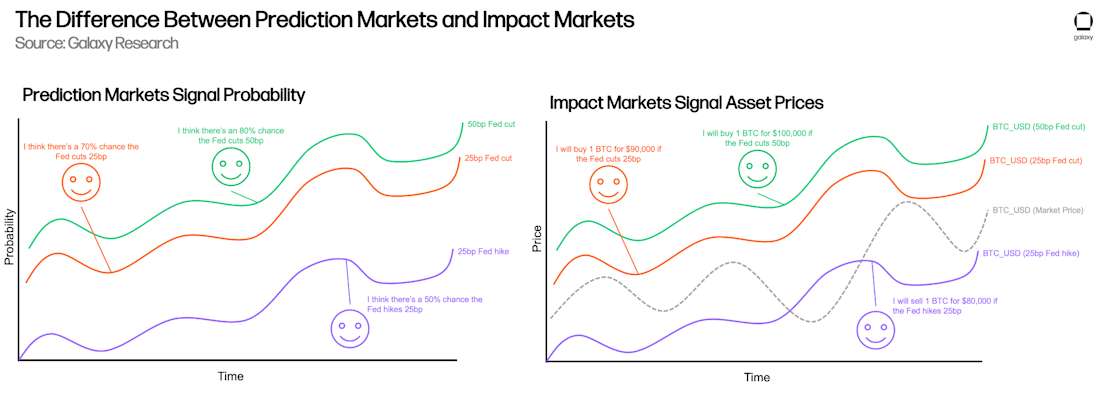
Impact Markets address a fundamental information gap: prediction markets today cannot tell you what an asset will be worth conditional on specific events occurring. This information doesn't exist in an explicitly discoverable form. While prediction markets reveal event probabilities and spot markets reveal prices, no mechanism surfaces the market's collective view on conditional asset valuations bound to specific events, such as where bitcoin would trade if the Fed were to cut 75 or 50 basis points, or how Nvidia shares would perform if an AI alarmist candidate won an important election.
Instead of trading probabilistic odds via synthetic yes/no tokens, Impact Market users directly trade the asset itself in conditional states where they express positions like "I am willing to buy BTC at $110,000 (a 10% premium to market) if and only if the Fed cuts 75 basis points." This fundamentally enhances what markets reveal. Rather than maintaining separate markets for "probability of Fed cut" and "BTC price," we get direct price discovery for "BTC price | Fed cuts 75bp." This idea can be extended to any asset | event pairing, such as “GOOGL | GPT 6 released before Gemini Series 4” or “Gold | Asteroid mining by 2030,” and so on.
The key distinction is there are events and there are the impacts those events have on companies and assets, which are two fundamentally different things. Prediction markets aggregate probabilities for whether events will occur. Impact Markets answer the next question: "What happens to this company or asset if this event occurs?" This separation allows each market type to specialize while creating a more complete information set.
Decision Markets
Decision Markets extend the Impact Markets mechanism from information revelation to governance automation. Rather than merely surfacing conditional valuations that inform individual decision-making, these markets directly and bindingly determine whether an organization takes an action based on which outcome the market prices higher. Decision Markets were born out of Hanson’s 2000 working paper entitled “Shall We Vote on Values, But Bet on Beliefs?”
The mechanism already exists in practice through futarchy DAOs, which have collectively traded millions of dollars in volume across their Decision Markets. In a typical setup, an organization proposes a decision (e.g. whether to dilute its token supply by 5% to fund a new product vertical) and the market trades two conditional “states”: Pass and Fail. Each state assigns its own value to the organization's token, whose price serves as the market’s objective function – that is, the thing it seeks to optimize. If the market prices the token higher in the Pass state, the organization proceeds with the decision. If the token in the Fail state trades higher, the proposal is rejected and no action is taken. Market participants collectively determine which action maximizes expected value, and their trades execute conditionally based on the winning outcome. Galaxy Research has covered these markets extensively and the organizations using them in reports on futarchy and its onchain implementation, and in our yearly predictions for 2025 and 2026.

For a deeper discussion on the implications of impact markets and decision markets, see Galaxy Research’s recent alert.
Opinion Markets
While prediction markets are anchored in objective outcomes (“Did X happen?”), “opinion markets” concern subjective questions and narratives. These markets do not rely on a hard external oracle or a binary resolution rule; instead, they function as sentiment gauges.
Many of the economically relevant questions in crypto, culture, and politics do not lend themselves to clean resolution criteria. For example:
Which L2 has the most mindshare right now?
Is sentiment more bullish or bearish after Powell’s last conference?
These questions matter because they influence capital allocation, but they cannot be resolved with a deterministic oracle. Opinion markets such as Noise.xyz allow speculation on narratives themselves rather than discrete outcomes.
Opinion markets are typically not resolved via deterministic oracles or binary settlement rules. Instead, they function as continuous sentiment instruments, where prices reflect the market’s collective view at a given moment rather than a final “correct” outcome. Traders win money if the opinion they bet on rises in price and lose money if it falls.
By contrast, prediction markets are fundamentally constrained by resolution requirements. To be tradeable, a question must be objectively verifiable, free from ambiguity, and resolvable by a trusted data source. For example, have a look at the rules below for Polymarket’s “What will Powell say during December Press Conference?”

Clear and precise criteria are required for prediction markets to function reliably.
Risks
Prediction markets are still relatively early. The path from “viral product” to durable financial primitive is not guaranteed.
Currently, the largest constraint is liquidity. The vast majority of markets have relatively thin orderbooks with wide spreads. Share prices can oftentimes be moved 10%+ with just a few thousand dollars. With these markets, probabilities can be misleading. Manipulation becomes a real concern here. Only the most liquid markets have reliable probabilities.
Theoretically, this will be solved over time as markets become more liquid, and as mentioned earlier, AI agents can help in effectively pricing the smaller markets. Regardless, illiquidity is a problem right now and will remain so in 2026.
Another risk lies in market construction and resolution logic. Prediction markets ultimately settle based on predefined rules, and ambiguity in definitions or misalignment between market titles and resolution criteria can degrade signal quality. We wrote about this problem recently in the case of Polymarket’s “Will the U.S. invade Venezuela by...” market, which sparked backlash after the market title differed from the resolution definition.
The oracle problem is another. Blockchains are not natively aware of the real world and require external infrastructure to pass real-world information into markets. The reliability and governance of these oracle mechanisms introduce additional points of risk, particularly when certain parties are financially incentivized to act in their own interests.
Regulatory backlash remains an overhang, especially as platforms expand beyond sports. Even compliant models could potentially face policy risk if prediction markets are framed as incentivizing harmful behavior or “betting on tragedy.” Just imagine even a single instance where someone is killed or injured in order to manipulate the resolution of a prediction market. The more mainstream these products become, the more likely they are to attract this sort of behavior. It sounds morbid, but we have seen similar things happen with pump.fun live streams in attempts to juice token prices. Humans will unfortunately take drastic measures for financial profits.
Outlook
Prediction markets are entering a transition from niche speculative products into foundational financial infrastructure. Event-linked contracts are increasingly behaving like derivatives, hedges, collateral, and information primitives.
In the near term, progress will be dictated less by novel market designs and more by liquidity formation. Despite rapid growth, most prediction markets remain thin, limiting their usefulness for sophisticated capital and constraining price reliability. Platforms that successfully combine strong retail distribution and regulatory clarity are best positioned to raise the baseline level of liquidity required for prediction markets to function as durable financial instruments.
Over the medium term, prediction markets will continue to blur into traditional derivatives. Simple binary contracts already serve as forward-like hedges in certain contexts, while leveraged prediction markets, credit layers, and options-style structures are expanding the capital efficiency of event trading. While these innovations are likely to accelerate adoption (particularly among institutional players and high-net-worth individuals), they will also import familiar risks from derivatives markets.
Artificial intelligence is poised to further accelerate this evolution. As the number of markets continues to grow and markets become more granular, human attention becomes the limiting factor.
AI agents can continuously price micro-markets and scan across venues for mispricings. Even low-liquidity markets can be priced efficiently at a low cost by agents.
Opinion markets, decision markets, and impact markets are likely to further expand prediction markets’ role. Together, these models are poised to shift prediction markets from forecasting whether events occur to pricing what they mean. This shift broadens their usefulness to portfolio construction and decision-making.

Prediction markets’ unsung utility, according to Matt Huang of Paradigm.
Looking ahead, the most likely outcome is a modular prediction markets ecosystem. Regulated venues, onchain protocols, wrappers, terminals, bots, and AI-driven interfaces will all contribute to the maturation of the space, each optimized for different users and risk preferences.
Prediction markets will converge toward a durable role as the financial infrastructure for trading uncertainty itself.
UPDATE (Jan. 20, 2026, 18:25 UTC): Removes Gnosis, an early Ethereum prediction market project that pivoted, from list of newer platforms.
Legal Disclosure:
This document, and the information contained herein, has been provided to you by Galaxy Digital Inc. and its affiliates (“Galaxy Digital”) solely for informational purposes. This document may not be reproduced or redistributed in whole or in part, in any format, without the express written approval of Galaxy Digital. Neither the information, nor any opinion contained in this document, constitutes an offer to buy or sell, or a solicitation of an offer to buy or sell, any advisory services, securities, futures, options or other financial instruments or to participate in any advisory services or trading strategy. Nothing contained in this document constitutes investment, legal or tax advice or is an endorsement of any of the stablecoins mentioned herein. You should make your own investigations and evaluations of the information herein. Any decisions based on information contained in this document are the sole responsibility of the reader. Readers should consult with their own advisors and rely on their independent judgement when making financial or investment decisions.
Prediction market examples are provided for illustrative purposes only. The use of leverage and collateralization involves a high degree of risk and may result in the loss of the entire principal amount.
Participants, along with Galaxy Digital, may hold financial interests in certain assets referenced in this content. Galaxy Digital regularly engages in buying and selling financial instruments, including through hedging transactions, for its own proprietary accounts and on behalf of its counterparties. Galaxy Digital also provides services to vehicles that invest in various asset classes. If the value of such assets increases, those vehicles may benefit, and Galaxy Digital’s service fees may increase accordingly. The information and analysis in this communication are based on technical, fundamental, and market considerations and do not represent a formal valuation. For more information, please refer to Galaxy’s public filings and statements. Certain asset classes discussed, including digital assets, may be volatile and involve risk, and actual market outcomes may differ materially from perspectives expressed here.
For additional risks related to digital assets, please refer to the risk factors contained in filings Galaxy Digital Inc. makes with the Securities and Exchange Commission (the “SEC”) from time to time, including in its Quarterly Report on Form 10-Q for the quarter ended September 30, 2025, filed with the SEC on November 10, 2025, available at www.sec.gov.
Certain statements in this document reflect Galaxy Digital’s views, estimates, opinions or predictions (which may be based on proprietary models and assumptions, including, in particular, Galaxy Digital’s views on the current and future market for certain digital assets), and there is no guarantee that these views, estimates, opinions or predictions are currently accurate or that they will be ultimately realized. To the extent these assumptions or models are not correct or circumstances change, the actual performance may vary substantially from, and be less than, the estimates included herein. None of Galaxy Digital nor any of its affiliates, shareholders, partners, members, directors, officers, management, employees or representatives makes any representation or warranty, express or implied, as to the accuracy or completeness of any of the information or any other information (whether communicated in written or oral form) transmitted or made available to you. Each of the aforementioned parties expressly disclaims any and all liability relating to or resulting from the use of this information. Certain information contained herein (including financial information) has been obtained from published and non-published sources. Such information has not been independently verified by Galaxy Digital and, Galaxy Digital, does not assume responsibility for the accuracy of such information. Affiliates of Galaxy Digital may have owned, hedged and sold or may own, hedge and sell investments in some of the digital assets, protocols, equities, or other financial instruments discussed in this document. Affiliates of Galaxy Digital may also lend to some of the protocols discussed in this document, the underlying collateral of which could be the native token subject to liquidation in the event of a margin call or closeout. The economic result of closing out the protocol loan could directly conflict with other Galaxy affiliates that hold investments in, and support, such token. Except where otherwise indicated, the information in this document is based on matters as they exist as of the date of preparation and not as of any future date, and will not be updated or otherwise revised to reflect information that subsequently becomes available, or circumstances existing or changes occurring after the date hereof. This document provides links to other Websites that we think might be of interest to you. Please note that when you click on one of these links, you may be moving to a provider’s website that is not associated with Galaxy Digital. These linked sites and their providers are not controlled by us, and we are not responsible for the contents or the proper operation of any linked site. The inclusion of any link does not imply our endorsement or our adoption of the statements therein. We encourage you to read the terms of use and privacy statements of these linked sites as their policies may differ from ours. The foregoing does not constitute a “research report” as defined by FINRA Rule 2241 or a “debt research report” as defined by FINRA Rule 2242 and was not prepared by Galaxy Digital Partners LLC. Similarly, the foregoing does not constitute a “research report” as defined by CFTC Regulation 23.605(a)(9) and was not prepared by Galaxy Derivatives LLC. For all inquiries, please email [email protected].
©Copyright Galaxy Digital Inc. 2026. All rights reserved.