


Prediction Markets’ Next Frontier: Impact and Decision Markets

Prediction markets achieved their "zero to one" moment in late 2024 and 2025, establishing themselves as mechanisms for aggregating dispersed information into probabilistic signals. The next use cases may extend this capability beyond answering whether events will occur to addressing what those events mean for asset prices and for organizational decisions.
We expect this expansion to take two forms: Impact Markets and Decision Markets. Impact Markets surface the market's collective view on conditional asset valuations (e.g. what bitcoin trades at if the Fed cuts 75 basis points or what Nvidia is worth if a specific candidate wins the election). Decision Markets go further, using these conditional valuations to automate organizational governance, allowing markets to directly determine which actions organizations take based on expected economic outcomes. A handful of projects are working to realize these concepts, and we expect the number to grow in the coming year and beyond as the ecosystem of products and users around them blossoms.
Both mechanisms build on prediction markets' ability to aggregate information through markets, but they shift the output from event probabilities to actionable intelligence. Rather than stopping at "this has a 65% chance of happening," these markets answer, "here's what it explicitly means for your portfolio" and "here's what your organization should do about it." The infrastructure and incentive structures are similar, but the potential scope of questions these markets can explicitly reveal is broader.
The Limitation: Event Probabilities vs. Economic Outcomes
The critical constraint today is that prediction markets offer binary payoffs for discrete events while remaining divorced from asset price outcomes. For example, users can bet on the chances the Federal Reserve cuts its benchmark interest rate by 25, 50, or 75 basis points, each with its own yes/no market and set of probabilistic outcomes. But they cannot directly trade, or explicitly disseminate signal around, what would happen to bonds, bitcoin, or any other asset contingent on those cuts occurring. The prediction market captures event probability but not how those events would influence asset prices. Such conditional pricing information could be valuable not just for hedging, but for informing strategic decisions.
The utility of prediction markets as hedging instruments and disseminators of information in their current form should not be understated. Prediction markets provide a direct mechanism to hedge any discrete event risks (e.g. the timing of ChatGPT's next model release or whether a military action occurs by a specific date) that would otherwise be impossible or difficult to isolate in traditional markets. Moreover, by aggregating the distributed knowledge of participants who have real capital at stake, prediction markets rapidly synthesize dispersed information into capital-opinionated, continuously updated probability that has historically outperformed expert forecasts and polls.
Impact Markets
Impact Markets address a fundamental information gap: prediction markets today cannot tell you what an asset will be worth conditional on specific events occurring. This information doesn't exist in an explicitly discoverable form. While prediction markets reveal event probabilities and spot markets reveal prices, no mechanism surfaces the market's collective view on conditional asset valuations bound to specific events, such as where bitcoin would trade if the Fed were to cut 75 or 50 basis points, or how Nvidia shares would perform at if an AI alarmist candidate won an important election.
Instead of trading probabilistic odds via synthetic yes/no tokens, Impact Market users directly trade the asset itself in conditional states where they express positions like "I am willing to buy BTC at $110,000 (a 10% premium to market) if and only if the Fed cuts 75 basis points." This fundamentally enhances what markets reveal. Rather than maintaining separate markets for "probability of Fed cut" and "BTC price," we get direct price discovery for "BTC price | Fed cuts 75bp." This idea can be extended to any asset | event pairing, such as “GOOGL | GPT 6 released before Gemini Series 4” or “Gold | Asteroid mining by 2030”, and so on.
The key distinction is there are events and there are the impacts those events have on companies and assets, which are two fundamentally different things. Prediction markets aggregate probabilities for whether events will occur. Impact Markets answer the next question: "What happens to this company or asset if this event occurs?" This separation allows each market type to specialize while creating a more complete information set.
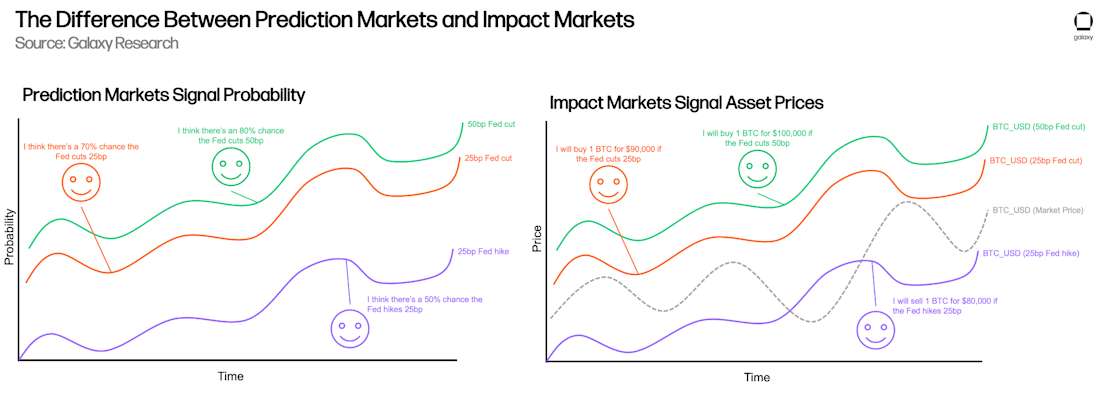
This architecture solves a multi-step inference problem that plagues the market: Traders must gather probabilistic odds from prediction markets, feed them into proprietary models to estimate asset impacts, then execute separate trades on exchanges. A trader seeing 25% odds of a 75 basis point cut and 65% odds of 25 basis point cut must independently determine what those probabilities mean for their BTC position, then hope their correlation assumptions hold when they execute (or hope that the Fed doesn’t surprise with a hike and blow their position up). Impact Markets collapse this entire workflow into direct price discovery of conditional valuations where trades only settle if the given event actually occurs.
The benefits are substantial:
Direct revelation of hidden information. No mechanism currently surfaces the market's collective view on conditional asset valuations bound to specific events. While prediction markets reveal event probabilities and spot markets reveal current prices, Impact Markets answer the question neither can directly: what this asset trades at if that event occurs.
True economic hedging. A bitcoin holder concerned about election impact can directly lock in a conditional price for their asset in the specific scenario they're worried about. This is fundamentally different from prediction market "hedging.” Instead of taking an opposing bet on event probability while separately managing their asset position, they execute a single trade that guarantees their economic outcome contingent on some event occurring. This minimizes basis risk between their event view and their asset exposure.
Redistribution of model risk. Impact markets transfer the burden of correlation estimation from every individual end user to the market's price discovery process. Today, any participant who wants to act on a conditional asset view must independently build or acquire a model mapping event probabilities to asset price movements — and bear the full consequences if that model is wrong. Impact markets shift this burden to the competitive dynamics between sophisticated market makers, who extract conditional distributions from options surfaces and prediction market data, and express their disagreements through quotes. The end user still faces the risk that the market-implied conditional price is wrong, but this is a fundamentally different (and smaller) risk than building a bespoke correlation model from scratch. The distinction is analogous to the difference between estimating implied volatility yourself versus reading it off an options chain (i.e. the market does the aggregation, and you decide whether to trade at the quoted level).
The most impactful (no pun intended) implication is that Impact Markets reveal market-implied joint distributions between events and asset prices, information that's hidden or requires complex model assumptions to extract under current prediction market architecture. This is valuable not just for hedging but for any decision that depends on understanding how events will affect economic outcomes.
Tailing this, organizations can effectively use this model to see into conditional futures and act accordingly. We call these Decision Markets.
Decision Markets
Decision Markets extend the Impact Markets mechanism from information revelation to governance automation. Rather than merely surfacing conditional valuations that inform individual decision-making, these markets directly and bindingly determine whether an organization takes an action based on which outcome the market prices higher. Decision Markets were born out of economist Robin Hanson’s 2000 working paper entitled “Shall We Vote on Values, But Bet on Beliefs?”
The mechanism already exists in practice through futarchy DAOs, which have collectively traded millions of dollars in volume across their Decision Markets. In a typical setup, an organization proposes a decision (e.g. whether to dilute its token supply by 5% to fund a new product vertical) and the market trades two conditional “states”: Pass and Fail. Each state assigns its own value to the organization's token, whose price serves as the market’s objective function – that is, the thing it seeks to optimize. If the market prices the token higher in the Pass state, the organization proceeds with the decision. If the token in the Fail state trades higher, the proposal is rejected and no action is taken. Market participants collectively determine which action maximizes expected value, and their trades execute conditionally based on the winning outcome. Galaxy Research has covered these markets extensively and the organizations using them in reports on futarchy and its onchain implementation, and in our yearly predictions for 2025 and 2026.

However, this structure exposes a critical constraint: the validity of the objective function. For Decision Markets to produce meaningful signals, the traded asset must be causally connected to the outcomes the decision aims to optimize; ideally, holders have material ownership claims over the economic value generated by the associated application. Many, if not most, crypto tokens fail this test. A chain's governance token cannot effectively guide ecosystem grant allocations when its value is structurally detached from the growth of applications built on the chain or if holders of the token are not materially entitled to the economic flow the chain generates. The market cannot reveal whether a grant will succeed if success (or detriment) won’t flow back to the asset being traded. Worse, rational traders may refuse to participate at all. Why buy a governance token (adding economic exposure to it) to signal support for an application grant when the application's success won't accrue value to the token? The market’s ability to accurately forecast the best decision breaks down when the objective function is misaligned with the decision domain.
This validity problem can make retrofitting Decision Markets onto existing organizations difficult. Established DAOs have already converged on specific governance processes, social norms, informal power structures, and (most critically) token and ownership structures that may not align token value with organizational outcomes. Introducing binding Decision Markets requires fundamental reorganization: how proposals are formed, how authority is exercised, how contributors act after a decision, and often how the organization itself is structured, because token ownership may need restructuring to adequately link economic outcomes to governance decisions. The human, coordination, and capital/legal costs to make this possible may be prohibitive for some organizations.
Newly formed organizations face no such constraints. They can be architected from inception with Decision Markets as the default coordination mechanism, designing token economics and governance processes specifically to ensure the objective function and expectations around governance processes (how and what is governed) remain valid. The tokens can be structured so that organizational success necessarily flows to token value, avoiding the disconnect that can plague existing organizations retrofitted for Decision Markets. As a result, Decision Markets are more likely to gain adoption through the formation of new market-native organizations purpose-built to let markets govern, rather than trying to graft markets onto legacy structures.
This suggests a path forward for Decision Markets broadly. Rather than replacing the coordination mechanisms on existing organizations, they enable entirely new organizational forms that were previously not possible. These are entities that can aggregate information, align incentives and ownership, and execute decisions through direct market mechanisms rather than political processes.
This creates both strengths and constraints. Decision Markets should excel at measuring risk/reward tradeoffs, maximizing return per unit of resource deployed, and pricing decisions made under high uncertainty. They're particularly powerful for capital allocation, resource deployment, and strategic choices where economic impact is the primary consideration. However, they're less suited for decisions where the stated goal includes qualitative factors, such as alignment, community social capital, or criteria that can't be reduced to token price. The market mechanism must optimize for economic value to generate meaningful signal. This is a feature, not a bug. Decision Markets are powerful precisely because they're reductive: they collapse complex tradeoffs into a single dimension of economic value. As a result, organizations relying on this structure may govern themselves differently than what is typical of onchain organizations today. Instead of micromanaging application details, they might focus governance on monthly contributor allowances and burn, treasury outflows, and asset control (including IP), while operators retain creative and day-to-day autonomy.
Conclusion
Prediction markets proved that markets could aggregate information about whether events will occur. Impact and Decision Markets stand to extend this insight by revealing what those events are worth and, in some cases, letting markets directly determine which actions organizations take. Impact Markets could close a critical information gap by surfacing conditional asset valuations, enabling true economic hedging and event-driven price discovery. Decision Markets would go further by using those valuations to govern capital allocation and strategy. Together, they would mark a shift from merely forecasting events to pricing consequences and acting on them. While these next-gen markets are in their infancy, the breakout success of prediction markets over the last two years augurs well for the next chapter of info finance.
Legal Disclosure:
This document, and the information contained herein, has been provided to you by Galaxy Digital Inc. and its affiliates (“Galaxy Digital”) solely for informational purposes. This document may not be reproduced or redistributed in whole or in part, in any format, without the express written approval of Galaxy Digital. Neither the information, nor any opinion contained in this document, constitutes an offer to buy or sell, or a solicitation of an offer to buy or sell, any advisory services, securities, futures, options or other financial instruments or to participate in any advisory services or trading strategy. Nothing contained in this document constitutes investment, legal or tax advice or is an endorsement of any of the stablecoins mentioned herein. You should make your own investigations and evaluations of the information herein. Any decisions based on information contained in this document are the sole responsibility of the reader. Readers should consult with their own advisors and rely on their independent judgement when making financial or investment decisions.
Participants, along with Galaxy Digital, may hold financial interests in certain assets referenced in this content. Galaxy Digital regularly engages in buying and selling financial instruments, including through hedging transactions, for its own proprietary accounts and on behalf of its counterparties. Galaxy Digital also provides services to vehicles that invest in various asset classes. If the value of such assets increases, those vehicles may benefit, and Galaxy Digital’s service fees may increase accordingly. The information and analysis in this communication are based on technical, fundamental, and market considerations and do not represent a formal valuation. For more information, please refer to Galaxy’s public filings and statements. Certain asset classes discussed, including digital assets, may be volatile and involve risk, and actual market outcomes may differ materially from perspectives expressed here.
For additional risks related to digital assets, please refer to the risk factors contained in filings Galaxy Digital Inc. makes with the Securities and Exchange Commission (the “SEC”) from time to time, including in its Quarterly Report on Form 10-Q for the quarter ended September 30, 2025, filed with the SEC on November 10, 2025, available at www.sec.gov.
Certain statements in this document reflect Galaxy Digital’s views, estimates, opinions or predictions (which may be based on proprietary models and assumptions, including, in particular, Galaxy Digital’s views on the current and future market for certain digital assets), and there is no guarantee that these views, estimates, opinions or predictions are currently accurate or that they will be ultimately realized. To the extent these assumptions or models are not correct or circumstances change, the actual performance may vary substantially from, and be less than, the estimates included herein. None of Galaxy Digital nor any of its affiliates, shareholders, partners, members, directors, officers, management, employees or representatives makes any representation or warranty, express or implied, as to the accuracy or completeness of any of the information or any other information (whether communicated in written or oral form) transmitted or made available to you. Each of the aforementioned parties expressly disclaims any and all liability relating to or resulting from the use of this information. Certain information contained herein (including financial information) has been obtained from published and non-published sources. Such information has not been independently verified by Galaxy Digital and, Galaxy Digital, does not assume responsibility for the accuracy of such information. Affiliates of Galaxy Digital may have owned, hedged and sold or may own, hedge and sell investments in some of the digital assets, protocols, equities, or other financial instruments discussed in this document. Affiliates of Galaxy Digital may also lend to some of the protocols discussed in this document, the underlying collateral of which could be the native token subject to liquidation in the event of a margin call or closeout. The economic result of closing out the protocol loan could directly conflict with other Galaxy affiliates that hold investments in, and support, such token. Except where otherwise indicated, the information in this document is based on matters as they exist as of the date of preparation and not as of any future date, and will not be updated or otherwise revised to reflect information that subsequently becomes available, or circumstances existing or changes occurring after the date hereof. This document provides links to other Websites that we think might be of interest to you. Please note that when you click on one of these links, you may be moving to a provider’s website that is not associated with Galaxy Digital. These linked sites and their providers are not controlled by us, and we are not responsible for the contents or the proper operation of any linked site. The inclusion of any link does not imply our endorsement or our adoption of the statements therein. We encourage you to read the terms of use and privacy statements of these linked sites as their policies may differ from ours. The foregoing does not constitute a “research report” as defined by FINRA Rule 2241 or a “debt research report” as defined by FINRA Rule 2242 and was not prepared by Galaxy Digital Partners LLC. Similarly, the foregoing does not constitute a “research report” as defined by CFTC Regulation 23.605(a)(9) and was not prepared by Galaxy Derivatives LLC. For all inquiries, please email [email protected].
©Copyright Galaxy Digital Inc. 2026. All rights reserved.