


Introduction
AI agents promise to transform the internet landscape. Already, continuous improvements in artificial intelligence have enabled agents to serve as coding assistants, shopping concierges, planning tools, and all other manner of subject-matter experts. They represent a powerful new primitive for how humans interact with the internet, mainly because they remove much of the need for humans themselves to directly engage with browsers and search engines.
In Galaxy Research’s 2024 report, Understanding the Intersection of Crypto and AI, we identified agents as one of the most promising growth verticals, noting that they are “well suited for crypto where users (or agents themselves) can create wallets for transacting with other services, agents, or people.” At the time, the agent space was nascent – limited by the intelligence of the underlying AI models, the infrastructure that enabled them to perform complex tasks, and the regulatory clarity needed for adoption beyond Web3-native contexts.
In just over a year since then, the progress on all three of the fronts has been astounding:
AI intelligence has progressed rapidly, enabling agents to “reason” over long horizons and autonomously execute complex tasks with increasing reliability.
Agent tooling has taken a leap forward with the release of foundational primitives including the Model Context Protocol (MCP), Agent-to-Agent (A2A) Protocol, Agent Payments Protocol (AP2), and the x402 standard.
Regulatory clarity, especially on the stablecoin front, has accelerated the integration of crypto payment rails.
Together, these developments have opened the door for the mass adoption of AI agents that leverage blockchain-based payments. One of the most promising advancements driving this trend is the emergence of x402 and related payment standards, which allow agents to pay for services and data directly using stablecoins or other crypto assets. For simplicity, we refer to this family of protocols collectively as agentic payment standards (APS) throughout this paper.
Simply put, APS give agents access to the internet’s full economic surface area. They can become smarter (by ingesting external data), more capable (by paying for resources), and more collaborative (by transacting with other agents). Beyond functionality, APS act as a bridge between the onchain and offchain economies, allowing any business to sell to the fastest emerging class of internet users – namely, agents – and accelerating the adoption of stablecoins for payments. APS also have the potential to improve the capital efficiency of an otherwise ignored economic engine by refactoring the business model for application programming interfaces (APIs, the standardized ways software requests data or services). Beyond economics, APS also bring forward fundamental changes to programming UX with respect to API key management. These changes make developing new applications easier.
This paper examines x402, one of the leading emerging onchain agentic payment standards. We situate x402 within the broader APS landscape and discuss its early adoption, use cases, and the tailwinds and headwinds that will determine whether blockchains can serve as the financial backbone of the emerging agentic economy.
The x402 Standard
Background
In May, Coinbase launched the x402 standard, a protocol that uses HTTP, the basic language servers use to communicate with each other, to enable crypto transactions in web interactions. Whereas previously transacting on the web depended on traditional payment rails (Visa, Mastercard, etc.), x402 opens the door for agentic payments that can access digital services using stablecoins and crypto.
x402 refers to a status code, “HTTP 402 Payment Required,” that was included in the original specification (spec) for the internet web protocol. Despite its inclusion at the onset of HTTP, 402 has largely sat dormant due to a lack of supporting infrastructure. Instead, a complementary payments infrastructure emerged, built by companies like Paypal and Stripe and reliant on traditional payment rails. While this infrastructure enabled the growth of e-commerce and significantly reduced payment frictions, it sat outside the inherent network capabilities of the internet.

The key unlock from x402 is that it is now much simpler for anyone (human or agent) to pay for online services. The standard aims to “enable value to move across the internet as seamlessly as information, whether the actor is a human, an app, or an agent,” according to the team that developed it. This is most frequently exemplified through the streamlining of API requests. As Coinbase’s own teams have succinctly put it, “Let’s kill the API key.”
Payment Flows
The payment flow for x402 is simple to understand. There are four primary components:
Client: The agent (or user’s software) that initiates the service request.
Server: The service provider that returns a 402 request and eventually delivers the paid resource.
Facilitator: Executes and/or verifies the payment.
Blockchain: The settlement layer where the actual stablecoin/crypto transfer happens.

Agents send a request to a server for some product or service (say, a streaming subscription or an ebook), which returns a “payment required” request (HTTP 402). This request includes fields such as the amount required, types of tokens accepted, wallet address to send the payment to, and blockchain to pay on.

Fields required for a 402 payment
The agent then responds to the payment request with all the required information and a cryptographic signature authorizing the payment. Finally, a facilitator handles the actual payment for the service on the blockchain and confirms it to the server, which then returns the requested service to the agent.
This is the standard payment flow that has been adopted with x402, but many different modifications are possible. For example, if an agent controls a wallet itself and can transact on a blockchain, it can submit the payment and verification to the server directly without relying on a facilitator. To date, however, facilitators have been used because they simplify the process by abstracting away the complexity of blockchain interactions like wallet management, gas payments, and network selection. In this respect, facilitators resemble traditional payment service providers, except at no point do they custody the funds or control the private keys of the wallet involved in the transaction. Instead, the agent, which controls the wallet, authorizes the what (“send up to X dollars from the payer to payee’s wallet”) and leaves the how (which chain, how much gas, etc.) to the facilitator.
x402 V2
On Dec. 11, Coinbase released x402 V2, a major upgrade based on feedback received over the past six months of usage. V2 begins the transition of x402 from a relatively simple but effective agentic payment specification into a more modular standard designed to adapt to evolving blockchain environments and support a broader range of payment use cases.
At a high level, x402 V2 expands the protocol along three key dimensions. First, it introduces a unified payment interface that supports multiple blockchains and assets through a single format, while enabling integration with legacy payment rails via facilitators. Second, it adds wallet-based identity and reusable access sessions, allowing clients to avoid repeated onchain interactions for subsequent requests—reducing latency and enabling higher-frequency use cases. Third, it enables automatic service discovery, allowing facilitators to index endpoints, pricing, and routing information without manual configuration.
Together, these changes allow x402 to support more sophisticated commercial models, including subscriptions, prepaid access, usage-based billing, and multi-step agent workflows.
The x402 Agentic Payment Stack
Increasingly, the x402 stack is starting to take shape. The pace at which projects and infrastructure are launching is exponential, but we have tried our best to capture as many projects as possible below.

All third-party logos are for identification purposes only and are property of their respective owners. Use of these logos and brands does not imply endorsement.
Value flow in the x402 payment stack begins at the agent layer and moves downward through coordination, execution, and settlement before propagating back up as fulfilled service access.
First, an agent or application initiates a task that requires access to a paid service, such as querying an API, retrieving proprietary data, or invoking another agent. The agent determines what it needs and under what constraints, including price, latency, preferred chain, or budget.
The coordination layer shapes how agents broadcast intents, discover services, exchange context (relevant information needed to complete a task), and coordinate workflows before payment occurs. It embeds additional functionality into agent workflows beyond what payment and settlement protocols alone provide, including mechanisms for service discovery, intent signaling, constraint enforcement (rules or limits such as budget, timing, or permissions), context management, and multi-step or multi-agent coordination.
Once terms are established, the agent initiates payment through the facilitation layer. Facilitators (services operated by third-party providers) handle routing, verification, and execution of the transaction, abstracting away blockchain-specific complexity and, when necessary, interfacing with legacy payment rails.
The currency layer defines what is transferred—typically stablecoins—enabling predictable pricing and programmable settlement suitable for high-frequency, machine-native transactions. USDC has been the dominant form of payment to date, but in theory any crypto can be used.
Finally, the blockchain layer executes and finalizes the transaction, providing cryptographic settlement and an auditable record. Confirmation then propagates back up the stack, allowing the service provider to deliver the requested resource to the agent.
Emerging Crypto Use Cases
As previously covered by Galaxy Research (here and here), x402 activity had an initial surge in activity in late October and early November after which activity has tapered off.

As is often the case when primitives are introduced in crypto, initial adoption and interest were primarily driven by speculative activities, with the late October spike caused by teams using x402 to mint and purchase memecoins. Since then, however, transaction volume and counts for agent-to-agent services, data as a service, and infrastructure and utilities have begun to account for an increasingly large percentage of transaction market share.

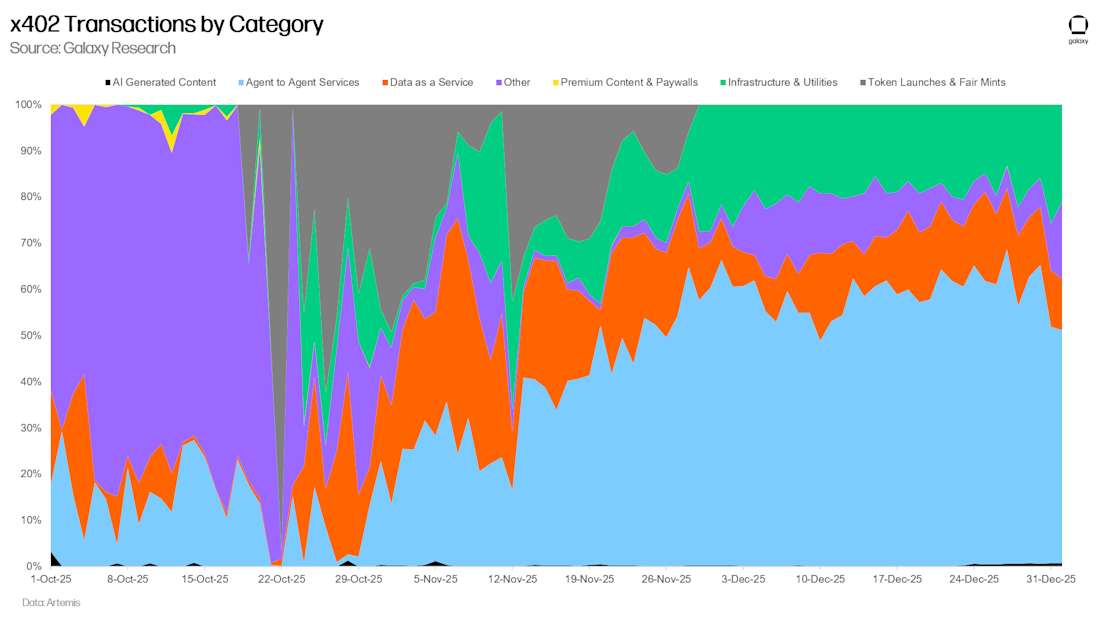
This has been the nature of permissionless offerings within crypto. Initial speculative use cases attract users, which then attract developers, who then begin to experiment with the technology and build beyond speculative use cases. Indeed, filtering across all transactions and volume for gaming (defined by Artemis Analytics as apparent self-dealing or wash trading) shows a drop below 50% since early December.

The most compelling use cases, and those most likely to persist over time, are those that leverage x402 to offer a differentiated product relative to what is possible with legacy payment rails. This primarily includes offerings that would otherwise be cost-prohibitive on traditional rails due to transaction fees, as well as use cases that require internet-native money where legacy systems are constrained by limited programmability, slow settlement times, and reliance on non-native intermediaries.
Today, these offerings are dominated by service providers enabling one-off API calls that would otherwise require subscriptions. Trading agents, for example, can pay for individual API calls to blockchain data provider Nansen or AI analysts to supplement their crypto analysis when needed. Beyond data access, x402 also enables agents to pay programmatically for infrastructure services—such as compute—that are difficult to price or automate using subscription-based or human-mediated payment models. Nous Research, a leading decentralized AI lab, has enabled x402 payments for access to its Hermes 4 model. x402 onchain activity and early use cases have been covered extensively elsewhere, and interested readers can refer to this recent piece by Lucas Shin of Artemis for additional detail.
While promising, these examples largely remain speculative proofs of concept that demonstrate the infrastructure’s capabilities rather than the growth drivers required for x402 adoption at scale. This is not meant to discredit any individual project or its potential, but rather to acknowledge that most onchain product offerings still primarily target crypto-native audiences and represent only a subset of potential applications. The following section explores additional use cases and the broader conditions required for agentic payment standards to scale.
Context and Data Access
One of the most compelling non-crypto use cases for agentic payment standards is paid access to online context and data. As AI agents increasingly rely on external information to perform tasks, the ability to programmatically purchase access to content on a per-request basis becomes critical.
Cloudflare provides an early example of how this model may emerge. As a major infrastructure provider that hosts and secures a significant portion of the internet, Cloudflare already mediates interactions between websites and automated traffic. In 2024, it introduced Pay-per-Crawl, a mechanism that allows bots and crawlers to pay for access rather than being blocked outright. Cloudflare has since indicated plans to integrate this infrastructure with x402 (the company partnered with Coinbase to launch the x402 Foundation), enabling agents to pay directly for access using internet-native payment rails. If standardized, this approach could transform bot mitigation from an access-control problem into a pricing and market-based mechanism. Simply put, an old nuisance is now a potential moneymaker.
This model extends naturally to paid content and proprietary data. Today, large language models primarily rely on internal training data and freely accessible sources such as Wikipedia. High-quality information, however, is often locked behind subscriptions or paywalls—such as news outlets, research databases, and analytics platforms. Under the current paradigm, accessing this data requires users to leave the agent interface, purchase subscriptions (even for one-time use), and manually transfer information, resulting in poor user experience and inefficient capital allocation.

Widely used AI systems like ChatGPT can’t autonomously access paywalled content, even when the information is required to complete a task.
Agentic payment standards offer an alternative. Users could assign explicit budgets to agents, allowing them to access paywalled content on a per-request or per-token basis. For example, an agent that requires access to a single article could submit an x402 request with a small payment attached, retrieve the relevant content, and complete the task without the user purchasing a full subscription. While this model may compress per-user margins for content providers, increased query volume and more granular pricing could offset these effects over time.
Taken together, context and data access represents a category where agentic payments offer a clear improvement over the legacy payment systems. It also illustrates how adoption of standards like x402 may originate outside of crypto-native environments, embedded within the infrastructure that already mediates interactions between agents, content, and the web.
E-Commerce
One of the most frequently discussed areas of agentic payment adoption is e-commerce. Agentic commerce is expected to grow rapidly over the coming decade, with estimates of $3 trillion to $5 trillion in B2C revenue by 2030. As a result, this segment has attracted significant attention from incumbent payment networks and processors, many of which are now proactively developing agent-native payment infrastructure.
In e-commerce, however, x402 adoption faces a more competitive environment than in API-native or micropayment-driven use cases. Retail transactions are typically higher value and less sensitive to per-transaction fees, reducing the relative advantage of ultra-low-cost blockchain settlement. More importantly, established payment providers already control the commercial and regulatory infrastructure that merchants depend on, and they are rapidly extending these capabilities to support autonomous agents without requiring onchain primitives.
Visa’s Intelligent Commerce suite (introduced in early 2025) enables consumers to provision Visa card credentials into AI agents for end-to-end shopping, with integrations across platforms such as OpenAI and Anthropic.
PayPal’s Agentic Commerce Services (October 2025) allow PayPal merchants to sell through agent interfaces like ChatGPT while preserving fraud detection, buyer protection, and merchant workflows.
Stripe’s Agentic Commerce Protocol (ACP), co-developed with OpenAI and announced in mid-2025, defines a standardized way for AI agents and merchants to initiate and complete purchases with minimal changes to Stripe integrations.
Mastercard’s Agent Pay (April 2025) tokenizes consumer credentials so AI systems such as Microsoft Copilot can execute purchases autonomously, with an early emphasis on subscriptions, loyalty redemptions, and programmable payments.
These initiatives can, in certain contexts, reduce the need for blockchain-based payment protocols by extending traditional payment rails into agent-native workflows, while in other contexts they may complement them. Two of the most prominent agentic payment standards gaining adoption, for example, are Google’s AP2 and Stripe’s ACP. While not yet the primary instantiation of how either is used, x402 can be integrated to facilitate stablecoin payments with either of them, either for two agents through A2A or for a merchant on ACP.
Below we provide an overview of Stripe’s push into agentic payments to better illustrate this dynamic.
Stripe’s Agentic Commerce Push
Stripe’s ACP is an open standard that defines how AI agents, merchants, and payment systems communicate during a checkout process. ACP standardizes the checkout conversation—such as item selection, pricing, confirmation, and completion—without dictating how funds are ultimately settled. It operates as a coordination layer for checkouts, not the payment rail itself, and is payment processor-agnostic, meaning merchants can adopt the protocol without changing payment providers.

To support secure payment authorization within this framework, Stripe introduced Shared Payment Tokens (SPTs). Despite the use of the term “token,” SPTs are not crypto assets and do not represent an independent payment rail. Instead, they function as scoped payment authorizations, allowing an agent to grant a merchant limited permission to charge a payment using whatever infrastructure the merchant prefers. This means the underlying settlement can be anything from cards to bank transfers to stablecoins.

Shared Payment Token payment flow
Together, ACP and SPTs enable agents to participate in e-commerce while preserving the guarantees merchants rely on, including fraud detection, dispute resolution, refunds, regulatory compliance, and customer support. Stripe has further smoothed integration by packaging these components into its Agentic Commerce Suite, a turnkey offering for merchants that want to support agent-driven purchases without redesigning their payment stacks.
How x402 and ACP Might Work Together
The distinction between Stripe’s agentic commerce stack and x402 is primarily one of scope and transaction context.
x402 is built for software paying other software. An agent sees a price, pays automatically, and immediately gets access to a service. This works well for APIs, data, and digital tools that agents use as part of their workflow.
ACP and SPTs are built for buying things. These purchases happen over a longer process, hold merchants responsible for fraud and refunds, and usually require a person to approve the payment.
To illustrate how these systems may coexist in practice, consider an AI agent tasked with planning and booking a vacation on a user’s behalf. First, the agent evaluates potential travel dates and destinations. To do so, it queries several specialized data providers, such as a premium weather forecasting service and a demand-forecasting API that predicts airfare volatility, that have integrated x402. The agent can programmatically discover pricing, pay for access, and retrieve this data on a per-request basis. These calls are non-reversible and don't require human intervention. Armed with this data, the agent determines optimal travel dates and moves to select a flight and hotel. At this point, the transaction shifts to an e-commerce workflow. The agent initiates a checkout with the airline or travel platform using ACP. Payment is authorized via an SPT, allowing the merchant to process the transaction while guaranteeing fraud protection, refunds, chargebacks, and compliance. The user reviews and approves the purchase, the booking is completed, and fulfillment follows.

In this workflow, x402 and ACP serve distinct but complementary roles. x402 is upstream of the checkout process and enables autonomous payment for resources that sit outside traditional commerce flows. Meanwhile, ACP handles regulated transactions where merchants require the protections and guarantees of incumbent payment systems and users must sign off on the payment before it happens. A distinct unlock here is the ability for the agent to seamlessly move between these payment models depending on context, selecting the mechanism best suited to each step of the task.
Beyond functional differences, there is an important structural distinction. x402 is designed as an open standard that settles on public, permissionless blockchains, enabling agents to transact without reliance on centralized intermediaries. By contrast, many incumbent-led agentic payment standards are open at the protocol level but operate primarily on permissioned platforms, where execution, compliance, and settlement remain tightly coupled to centralized payment providers. These approaches support different use cases and trust models and are not mutually exclusive. In practice, hybrid architectures are likely to emerge, with agents leveraging permissionless rails for machine-native transactions while relying on permissioned systems for regulated commerce and consumer-facing payments.
Conclusion
Rather than triggering an immediate migration toward onchain payments, agentic payments are more likely to drive gradual and largely invisible blockchain adoption over time. Stablecoins accelerate this shift by reducing friction when interfacing with legacy systems, while infrastructure such as x402 enables new forms of experimentation that traditional payment rails struggle to support.
In the near term, adoption is likely to be uneven. Certain use cases, particularly payments between agents and digital services, are likely to move quickly, while consumer-facing commerce will change little. In many cases, blockchains will operate behind the scenes, embedded within agent workflows rather than presented directly to end users.
The most immediate and underappreciated impact of agentic payment standards lies not in commerce, but in software production. For many non-production-scale tasks, modern language models have already reached a level of capability where human involvement is largely redundant. Today, the primary points of friction are not intelligence or execution, but access: purchasing API subscriptions, managing accounts, handling API keys, and paying for bundled services that are rarely used to capacity. If agentic payment standards can remove these frictions—by replacing subscription-based access and manual key management with pay-as-you-go, machine-native payments—they could materially lower the cost of experimentation and compress the value of entry-level software engineering work.
From this perspective, x402’s most compelling near-term application is not abstract agent-to-agent commerce, but micropayments for API and data access. Allowing agents to pay for individual API calls or discrete units of context unlocks a more capital-efficient model for users and providers. Rather than overpaying for subscriptions, users can allocate explicit budgets—such as a fixed monthly allowance—for their agents to autonomously purchase data, analytics, or context as needed. This model better aligns incentives, improves user experience, and expands the economic surface area available to AI systems.
Over time, the question shifts from whether blockchains are used to where and how they are used. Incumbents are already experimenting with stablecoins and blockchain rails alongside agentic payment capabilities, suggesting that onchain settlement will increasingly coexist with traditional payment infrastructure. The open question is whether this activity consolidates on permissioned or federated blockchains controlled by centralized entities, or on open, permissionless networks such as Ethereum or Solana. Most likely, it will be a bit of each.
More broadly, the emergence of agentic payment standards reflects a shift in how crypto will be adopted. Rather than forming a standalone industry, blockchain infrastructure is increasingly being absorbed into existing financial and software systems. In this model, success is not defined by the growth of a separate “crypto economy,” but by how often crypto-native rails quietly power applications that do not identify as crypto at all. x402 is a clear example of this dynamic. By embedding payments directly into standard web interactions, it positions blockchains as backend infrastructure—delivering programmability and global settlement without requiring users or developers to engage with crypto explicitly.
Onchain agentic payments are unlikely to replace the incumbent payments ecosystem outright. Instead, they will augment it, first in areas where machine-native money offers clear advantages—such as automated access to APIs, data, and digital services—and only later in higher-value commerce flows. In doing so, they may quietly reshape how software is built, priced, and consumed, positioning blockchains not as a visible endpoint, but as a foundational layer of the emerging agent-driven internet.
Legal Disclosure:
This document, and the information contained herein, has been provided to you by Galaxy Digital Inc. and its affiliates (“Galaxy Digital”) solely for informational purposes. This document may not be reproduced or redistributed in whole or in part, in any format, without the express written approval of Galaxy Digital. Neither the information, nor any opinion contained in this document, constitutes an offer to buy or sell, or a solicitation of an offer to buy or sell, any advisory services, securities, futures, options or other financial instruments or to participate in any advisory services or trading strategy. Nothing contained in this document constitutes investment, legal or tax advice or is an endorsement of any of the stablecoins mentioned herein. You should make your own investigations and evaluations of the information herein. Any decisions based on information contained in this document are the sole responsibility of the reader. Readers should consult with their own advisors and rely on their independent judgement when making financial or investment decisions.
Participants, along with Galaxy Digital, may hold financial interests in certain assets referenced in this content. Galaxy Digital regularly engages in buying and selling financial instruments, including through hedging transactions, for its own proprietary accounts and on behalf of its counterparties. Galaxy Digital also provides services to vehicles that invest in various asset classes. If the value of such assets increases, those vehicles may benefit, and Galaxy Digital’s service fees may increase accordingly. The information and analysis in this communication are based on technical, fundamental, and market considerations and do not represent a formal valuation. For more information, please refer to Galaxy’s public filings and statements. Certain asset classes discussed, including digital assets, may be volatile and involve risk, and actual market outcomes may differ materially from perspectives expressed here.
For additional risks related to digital assets, please refer to the risk factors contained in filings Galaxy Digital Inc. makes with the Securities and Exchange Commission (the “SEC”) from time to time, including in its Quarterly Report on Form 10-Q for the quarter ended September 30, 2025, filed with the SEC on November 10, 2025, available at www.sec.gov.
Certain statements in this document reflect Galaxy Digital’s views, estimates, opinions or predictions (which may be based on proprietary models and assumptions, including, in particular, Galaxy Digital’s views on the current and future market for certain digital assets), and there is no guarantee that these views, estimates, opinions or predictions are currently accurate or that they will be ultimately realized. To the extent these assumptions or models are not correct or circumstances change, the actual performance may vary substantially from, and be less than, the estimates included herein. None of Galaxy Digital nor any of its affiliates, shareholders, partners, members, directors, officers, management, employees or representatives makes any representation or warranty, express or implied, as to the accuracy or completeness of any of the information or any other information (whether communicated in written or oral form) transmitted or made available to you. Each of the aforementioned parties expressly disclaims any and all liability relating to or resulting from the use of this information. Certain information contained herein (including financial information) has been obtained from published and non-published sources. Such information has not been independently verified by Galaxy Digital and, Galaxy Digital, does not assume responsibility for the accuracy of such information. Affiliates of Galaxy Digital may have owned, hedged and sold or may own, hedge and sell investments in some of the digital assets, protocols, equities, or other financial instruments discussed in this document. Affiliates of Galaxy Digital may also lend to some of the protocols discussed in this document, the underlying collateral of which could be the native token subject to liquidation in the event of a margin call or closeout. The economic result of closing out the protocol loan could directly conflict with other Galaxy affiliates that hold investments in, and support, such token. Except where otherwise indicated, the information in this document is based on matters as they exist as of the date of preparation and not as of any future date, and will not be updated or otherwise revised to reflect information that subsequently becomes available, or circumstances existing or changes occurring after the date hereof. This document provides links to other Websites that we think might be of interest to you. Please note that when you click on one of these links, you may be moving to a provider’s website that is not associated with Galaxy Digital. These linked sites and their providers are not controlled by us, and we are not responsible for the contents or the proper operation of any linked site. The inclusion of any link does not imply our endorsement or our adoption of the statements therein. We encourage you to read the terms of use and privacy statements of these linked sites as their policies may differ from ours. The foregoing does not constitute a “research report” as defined by FINRA Rule 2241 or a “debt research report” as defined by FINRA Rule 2242 and was not prepared by Galaxy Digital Partners LLC. Similarly, the foregoing does not constitute a “research report” as defined by CFTC Regulation 23.605(a)(9) and was not prepared by Galaxy Derivatives LLC. For all inquiries, please email [email protected].
©Copyright Galaxy Digital Inc. 2026. All rights reserved.