

Backing Ornn: The Financial Layer for Compute

On the coattails of increasing AI capex, compute is on its path to becoming a multi-trillion-dollar commodity with $650 billion projected for compute spend in 2026 alone. However, unlike mature commodities such as oil, power, and metals, there is no standardized pricing reference, no forward curves, and no scalable instrument to manage risk. Neoclouds, data centers, and asset backed lending desks hold several billion dollars’ worth of GPUs on balance sheets with no coherent way to hedge or transfer price and inventory risk. Ornn is working to bridge this gap for the financialization of compute.
Galaxy is proud to participate in the $33M Seed investment round for Ornn, a company building financial derivatives for compute markets. Ornn offers three core products – the Ornn Compute Price Index, the Ornn Compute platform, and structured financial instruments for residual value protection.
The Missing Market Structure for Compute
Compute is rapidly becoming one of the largest asset class in the world, but this immense capex reallocation is happening without the core financial instruments that serve other commodity classes today. Four structural issues are prevalent in compute financial markets as they stand today:
Standardizing heterogeneity: GPU-hours are inherently heterogeneous today with idiosyncrasies across GPU architecture, workloads, location, and several other parameters. Creating a reliable price index that tracks and updates pricing in real-time requires meticulous granularity before it can serve as a trusted benchmark for risk transfer.
Complexity and opacity: Transactions around AI infrastructure are not transparent. Offtakers sign opaque contracts with no public benchmark to price against, and operators underwrite tenants one cluster at a time. Pricing real-time compute cost and depreciation is genuinely hard, owing to (i) a lack of data, (ii) high variance across parameters, (iii) discontinuous, jump-like repricing when new chips launch, and (iv) ever-evolving use cases for older chip generations.
Unmanaged risk: Data centers and neoclouds sign three-to-five-year contracts for GPU clusters but have limited visibility into utilization – or resale value – after the contract period, while bearing the full depreciation risk as newer chips arrive. Asset-backed lenders underwriting GPU-collateralized loans face the same exposure with no mechanism to hedge it.
Expensive financing: Shaving 50–100 basis points off the cost of capital on a GPU-backed facility, through a forward curve or a residual-value floor, can potentially translate into meaningful savings across a market this size. Until recently, those risk transfer instruments and venues to trade those instruments were non-existent.
Compute Financial Markets
The above market structure gaps constrain how efficiently capital reallocation towards compute can flow. Without a trusted reference price, the instruments to hedge it, or a liquid venue for spot capacity, financing stays expensive and risk stays stranded on balance sheets. Each layer has historically taken years to develop for other commodities.
Ornn has built all three layers at once for compute.
The Price Layer: OCPI. The Ornn Compute Price Index (OCPI) is a settlement-grade price index built from real-time transaction data across hardware classes and geographies. Ornn offers price indices across GPUs (H100s, A100s, B200s, etc.), Memory (DRAM, Flash, and Module), and most recently across AI model tokens (Anthropic, OpenAI, DeepSeek, etc.).
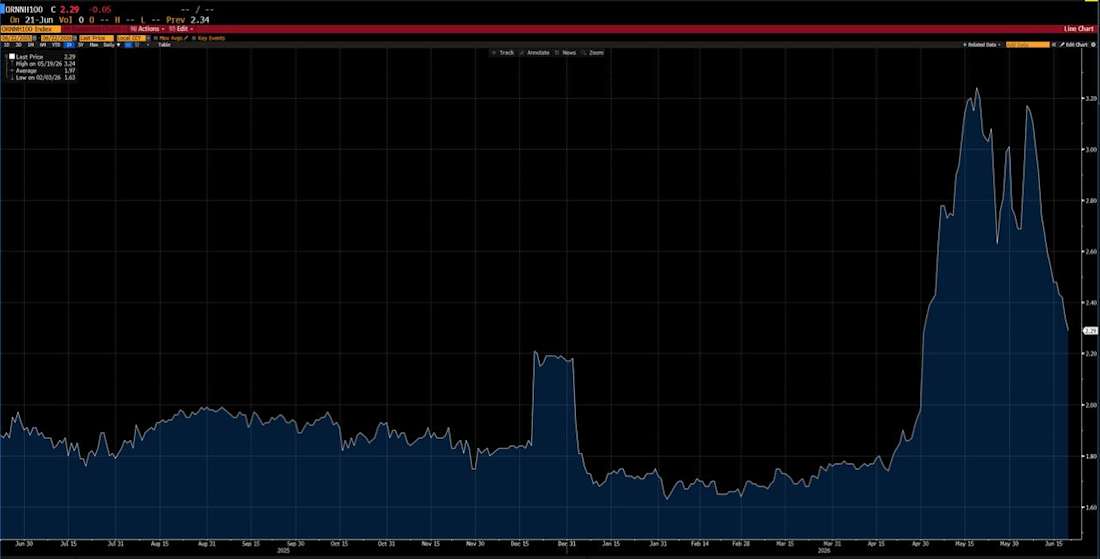
Ornn H100 Index. Source: Bloomberg The Risk-Transfer Layer: Futures and puts. A tradeable price index allows for price discovery and expectedly risk transfer. Ornn's GPU-hour futures reference OCPI and clear through exchanges such as ICE futures – creating a verifiable forward curve for GPU price risk.
The Capacity Layer: Ornn Compute, which is an aggregator platform for GPU capacity across neoclouds. As discussed above, offtake agreements are largely opaque with limited visibility into reference market pricing before signing into a contract. By creating a marketplace where trusted operators and offtakers can meet, Ornn Compute works to transform dedicated capacity from a relationship-based, obscure pricing regime to a transparent and liquid process.
Why We Invested
Given our data center operations at Helios and our position as a leading financial-services firm, new capital markets for an emergent asset class were a natural area of interest for us at Galaxy Ventures.
We believe most durable capital-markets innovations are built on three tenets: trust, vertical integration, and structural demand. Ornn stands out on all three, in our view.
Firstly, Ornn is positioned to become a key benchmark for the compute economy. With robust price indexes across GPUs, Memory, and AI tokens and with traded products on exchanges such as ICE – Ornn is a venue for price discovery and risk transfer across all facets of AI infrastructure buildout.
Secondly, Ornn occupies the entire financial stack for compute. From index licensing to tradeable financial derivatives to a spot marketplace for GPU capacity – Ornn is front and center at the colosseum of GPU activity.
Finally, Ornn captures significant unmet demand. With $650 billion in compute spend allocated across just Google, Amazon, Meta, and Microsoft for 2026 and with overall compute spend estimated to reach $7 trillion by 2030 – structured financial products to manage risk could become commonplace and we are confident that Ornn’s Price Index is designed to serve as the reference point to settle risk against.
Solving hard problems can accrue compounding value, and financializing compute markets is among the hardest problems out there. Heterogeneity was true of oil, electricity, and LNG futures early on. In each, a liquid market eventually emerged around an underlying spot index that matured into the trillion-volume derivative products they have become today. We are excited to back Kush and Wayne in their journey to create the financial substrate for all of compute.
If you are building in compute markets and are interested in working together, reach out to [email protected].
Ornn is a portfolio company of Galaxy Ventures.
Third-party data provided is unaudited and subject to methodological assumptions. Past performance is not indicative of future results.
Legal Disclosure:
This document, and the information contained herein, has been provided to you by Galaxy Digital Inc. and its affiliates (“Galaxy Digital”) solely for informational purposes. This document may not be reproduced or redistributed in whole or in part, in any format, without the express written approval of Galaxy Digital. Neither the information, nor any opinion contained in this document, constitutes an offer to buy or sell, or a solicitation of an offer to buy or sell, any advisory services, securities, futures, options or other financial instruments or to participate in any advisory services or trading strategy. Nothing contained in this document constitutes investment, legal or tax advice or is an endorsement of any of the stablecoins mentioned herein. You should make your own investigations and evaluations of the information herein. Any decisions based on information contained in this document are the sole responsibility of the reader. Readers should consult with their own advisors and rely on their independent judgement when making financial or investment decisions.
Participants, along with Galaxy Digital, may hold financial interests in certain assets referenced in this content. Galaxy Digital regularly engages in buying and selling financial instruments, including through hedging transactions, for its own proprietary accounts and on behalf of its counterparties. Galaxy Digital also provides services to vehicles that invest in various asset classes. If the value of such assets increases, those vehicles may benefit, and Galaxy Digital’s service fees may increase accordingly. The information and analysis in this communication are based on technical, fundamental, and market considerations and do not represent a formal valuation. For more information, please refer to Galaxy’s public filings and statements. Certain asset classes discussed, including digital assets, may be volatile and involve risk, and actual market outcomes may differ materially from perspectives expressed here.
For additional risks related to digital assets, please refer to the risk factors contained in filings Galaxy Digital Inc. makes with the Securities and Exchange Commission (the “SEC”) from time to time, including in its Quarterly Report on Form 10-Q for the quarter ended September 30, 2025, filed with the SEC on November 10, 2025, available at www.sec.gov.
Certain statements in this document reflect Galaxy Digital’s views, estimates, opinions or predictions (which may be based on proprietary models and assumptions, including, in particular, Galaxy Digital’s views on the current and future market for certain digital assets), and there is no guarantee that these views, estimates, opinions or predictions are currently accurate or that they will be ultimately realized. To the extent these assumptions or models are not correct or circumstances change, the actual performance may vary substantially from, and be less than, the estimates included herein. None of Galaxy Digital nor any of its affiliates, shareholders, partners, members, directors, officers, management, employees or representatives makes any representation or warranty, express or implied, as to the accuracy or completeness of any of the information or any other information (whether communicated in written or oral form) transmitted or made available to you. Each of the aforementioned parties expressly disclaims any and all liability relating to or resulting from the use of this information. Certain information contained herein (including financial information) has been obtained from published and non-published sources. Such information has not been independently verified by Galaxy Digital and, Galaxy Digital, does not assume responsibility for the accuracy of such information. Affiliates of Galaxy Digital may have owned, hedged and sold or may own, hedge and sell investments in some of the digital assets, protocols, equities, or other financial instruments discussed in this document. Affiliates of Galaxy Digital may also lend to some of the protocols discussed in this document, the underlying collateral of which could be the native token subject to liquidation in the event of a margin call or closeout. The economic result of closing out the protocol loan could directly conflict with other Galaxy affiliates that hold investments in, and support, such token. Except where otherwise indicated, the information in this document is based on matters as they exist as of the date of preparation and not as of any future date, and will not be updated or otherwise revised to reflect information that subsequently becomes available, or circumstances existing or changes occurring after the date hereof. This document provides links to other Websites that we think might be of interest to you. Please note that when you click on one of these links, you may be moving to a provider’s website that is not associated with Galaxy Digital. These linked sites and their providers are not controlled by us, and we are not responsible for the contents or the proper operation of any linked site. The inclusion of any link does not imply our endorsement or our adoption of the statements therein. We encourage you to read the terms of use and privacy statements of these linked sites as their policies may differ from ours. The foregoing does not constitute a “research report” as defined by FINRA Rule 2241 or a “debt research report” as defined by FINRA Rule 2242 and was not prepared by Galaxy Digital Partners LLC. Similarly, the foregoing does not constitute a “research report” as defined by CFTC Regulation 23.605(a)(9) and was not prepared by Galaxy Derivatives LLC. For all inquiries, please email [email protected].
©Copyright Galaxy Digital Inc. 2026. All rights reserved.